
2025 was a year of massive experiments, immense enthusiasm, and often unrealistic expectations. Now, an inevitable correction is coming. While CFOs are looking for tangible ROI on generative AI in their budgets, security teams are facing the growing risk of „Shadow AI“.
The phase of uncritical admiration for AI’s ability to write a poem or summarize an email is over. Especially in the enterprise environment, the time has come to build functional, secure, and auditable infrastructure.
The end of the „Chatterbox“ era
Many companies entered the AI world by purchasing thousands of universal assistant licenses. However, the initial excitement was quickly replaced by questions about actual business value. The problem isn’t the technology itself, but how it’s deployed. If AI remains just a side-panel add-on in a browser, its benefits will inevitably hit a ceiling.
True productivity doesn’t grow just by chatting with a bot, but through task automation. The future belongs to Agentic Workflows, engines that naturally integrate into existing infrastructure and can extract value across systems, from email inboxes and SharePoint to corporate Jira or CRM.
Why enterprise AI is (currently) struggling
The statistics are ruthless: most corporate AI projects today end up in „PoC Purgatory“. Innovation teams might create attractive demos, but they crash the moment they need to be deployed into real operations. The reasons constantly repeat themselves:
- Unprepared Processes and Data: AI is not a magic pill for data chaos. If internal processes are missing, advanced automation cannot function.
- Lack of Trust in Truth (Hallucinations): Without a precise reference to a specific corporate document and paragraph, an AI’s answer is just a good guess, not a valid basis for work.
- Absence of Mature Tools: The market often offers either closed global ecosystems or immature open-source solutions lacking enterprise stability.
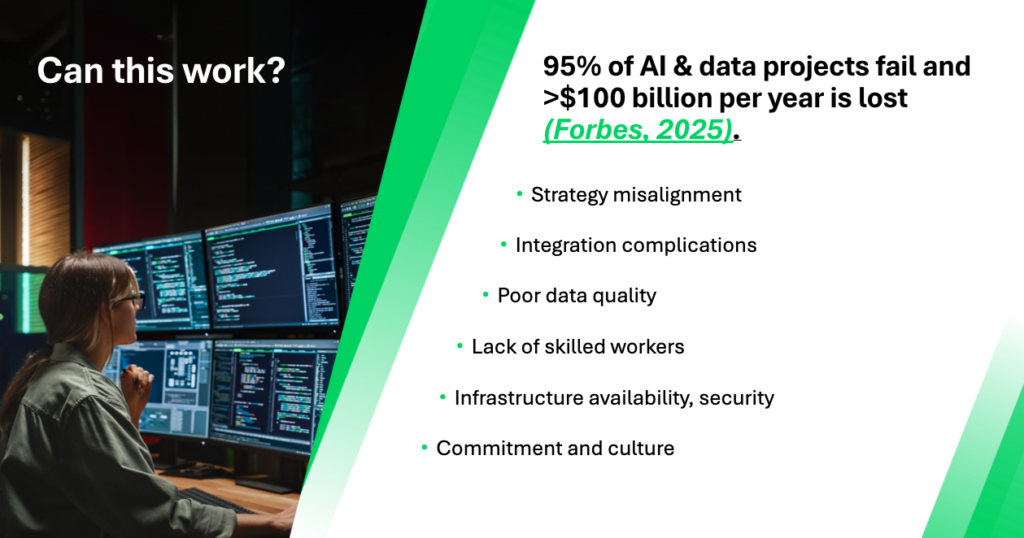
The path from PoC purgatory: Architecture eeady for production
The statistics are ruthless: most corporate AI projects today end up in so-called „PoC Purgatory.“ Innovation teams might create attractive demos, but they hit a wall the moment they need to be deployed into real-world operations. The reasons are always the same: security concerns, hallucinations, or the system’s inability to run within the company’s closed environment.
For AI to become a reliable part of everyday work, it must be „Enterprise-Ready“ from day one.
(Author’s note: See how an AI system can be designed in such a way. The architecture has to guarantee data sovereignty, ensuring that data never leaves the company perimeter. Strict access management (RBAC/ABAC) is an absolute necessity.)
Three strategic pillars for enterprise AI in 2026
- Security is not a roadblock, but a prerequisite: AI must not send sensitive data to the public cloud. It needs to run where your data lives, ideally on-premise (for maximum security) or in a hybrid setup where data remains on-premise and the model runs in a contractually guaranteed private cloud environment (an acceptable risk).
- Agents, not chatterboxes (and templates to start fast): Demand agents that execute specific steps and workflows based on your data, rather than just generating paragraphs of text. Furthermore, a general AI model is essentially a blank slate. To quickly transform it into a specialized business tool, a mature system should offer pre-built agents and ready-to-use templates for both chat and document processing. Instead of forcing your employees to become prompt engineers, you can provide them with pre-configured workflows for common tasks—such as contract analysis, HR onboarding, or IT support. This is the fastest way to bridge the gap between generic AI and immediate, measurable business value.
- Respect for the existing ecosystem: The true value lies in connecting AI seamlessly to your current infrastructure—your emails, SharePoint, corporate Jira, CRM, ERP, and other critical systems.
How to tackle shadow AI without pointless bans
Shadow AI is actually just a symptom of dysfunctional internal tools. Employees who want to work efficiently often upload sensitive documents to public chats in good faith. Bans simply don’t work.
The solution is to offer a system that is as intuitive as public tools but under the company’s full control. The three strategic pillars for a mature AI infrastructure are:
- Data Sovereignty: AI must run where the data is. Whether that means an on-premise deployment (highest security) or a guaranteed private cloud environment.
- Intelligent Classification and Data Protection: The system must have mechanism how to work with PII (personally identifiable information) and (e.g.) mask it before it becomes a security risk.
- Respect for Existing Rights (RBAC): The AI model must not see data that the user does not have access to within the corporate identity framework (e.g., Entra ID).
Demand „Mature“ AI
The true value of AI emerges the moment it securely „reads“ your service manuals, connects them with ERP processes, and executes the required action. The companies that gain a competitive advantage in the coming years won’t be those with the funniest chatbot, but those that can integrate AI into deep processes without losing control over their own data.
The year 2025 will go down in history as the time when artificial intelligence packed its bags in the B2C amusement park and permanently moved into the serious B2B world. Systems that prioritize security, data sovereignty, and process integration over generating jokes about pirates will inevitably start popping up everywhere.
…And by pure, sheer coincidence (okay, I admit, it wasn’t a coincidence at all), my team at EmbedIT and I are working on exactly such a system right now. It’s called Aisbear. We aren’t building just another „digital companion“ for your spare time, but a robust knowledge hub and an on-premise integration layer for enterprise clients. We are giving modern technologies a solid framework, order, and auditability.
Because that is exactly what regulated businesses need the most right now: less hype, more actual work done.
References